Thursday, October 7, 2010

Horrorfest 2010: Deep Red

Now THIS is greatness.

DEEP RED is another Italian flick, this time by Dario Argento. He's probably most famous for SUSPIRIA, which I saw a couple years ago. I liked SUSPIRIA but I don't remember loving it the way I love this one. Maybe my memory is fading, or maybe DEEP RED is just that amazing.

DEEP RED is the story of a musical teacher (David Hemmings) who begins a murder investigation when he witnesses the murder of his downstairs neighbor (Macha Meril). The early scenes of the film reveal the neighbor to be a psychic who can't see into the future but who can read minds. In a demonstration of her abilities during a lecture with her parapsychologist colleague (Glauco Mauri), the psychic senses a twisted murderer in the audience, and later vows to write down the details of her vision. Soon, she's found dead.

Hemmings' character is aided in his investigation by a goofy but cute reporter (Daria Nicolodi). He's tortured by the fact that he swears he saw some kind of clue in the apartment when he first responded to the crime, but he can't remember what it was. He seems to think it was a painting of some importance but is unable to put his finger on it. This obsession drives him into dangerous territory as he gets closer to uncovering the identity of the murderer and there are a few good red herrings along the way.

The first scare comes about halfway through the opening credits. Defying convention, the credits are interrupted to suddenly drop the viewer in the middle of the scene of a disturbing crime. Then, as if nothing happened, the credits start back up again. This is Argento telling us he means business, but that he's also messing with us.

Almost every shot in this movie crackles with energy. Argento didn't phone a single one in. Every sequence clips along at a brisk pace while also managing to be suspenseful. The whole thing is pushed along by a genius score by the prog rock band Goblin, probably most famous for their DAWN OF THE DEAD score, but outdoing themselves here as their driving beats are ironically matched to the most nail biting sequences. I want this soundtrack. It's like Procul Harum ditched their lead singer and hit fast forward.

You never get a good look at the killer until the end, but the killer has several calling cards that keep things creepy. First of all, the killer is obsessed with a childhood sing-along tune, so whenever you hear it, you know you're in danger. Secondly, the killer tends to hang baby dolls in effigy, or unleash disturbing wind up toys to taunt victims. One of the freakiest moments in the film involves the totally unexpected entrance of one of these calling cards -- at once surreal and startling.

Everything in this movie is crisp -- the visuals are painstakingly shot with a sharpness usually reserved for art films. The editing clips along ruthlessly playing the audience like Hemmings' character might play the piano. Even the soundtrack bursts forward, sounding fresh and energetic.

Argento does a great job of taking the mundane and making it frightening. We got a creepy junior high school, the most frightening scalding bath ever, a murder scene illustrating the dangers of sharp corners in ones' home, and a brilliant sequence in which wallpaper is scraped away to reveal ghastly clues of past depravity in an empty home.

Make no mistake: DEEP RED is the real thing.

Horrorfest 2010: Blood and Black Lace

There are a ton of foreign films on the "best horror films" list I'm working off of and a lot of them are Italian, like BLOOD AND BLACK LACE. I've been aware of the golden-age of Italian horror for a while now, but I've only dipped into it a little bit, checking out some Lucio Fulci here and a some Dario Argento there. This one's directed by the other Italian horror master, Mario Bava, and is credited for starting the "slasher" genre in which more attention is given to the killer and his/her stalking and murdering than to the actual mystery or murder investigation.

What is the difference between this, one of the earliest examples of the Slasher, and the films (good and bad) that would follow and become so popular in Hollywood? I guess the main thing is above all BLOOD AND BLACK LACE is stylish and interesting to look at.

That's appropriate for a movie that takes place in the world of fashion. It stars Cameron Mitchell and Eva Bartok as two proprieters of a "fashion house" who are also romantically involved. Bartok's character has recently lost her husband under mysterious circumstances and the fashion models who work at the fashion house observe that her demeanor hasn't been the same since his death. The fashion house itself is a big, gaudy, baroque mansion lit with primary colors that give way to dark shadows. Curtains hang everywhere and creepy mannequins stand around every corner.

The action starts off with the murder of one of the models, Isabella (Francesca Ungaro). As the death is investigated by the police, all of the models working at the fashion house realize their dirty secrets could be revealed if Isabella's controversial diary is found. One girl resolves to turn the diary over to the police, but the others attempt to conceal it and the secrets within -- tales including abortion and drug abuse. One by one they're visited by Isabella's killer, a figure in a black trench coat and fedora with a blank, featureless, white face.

So, at the time, the movie was unique because of the emphasis it put on the stalking and killing scenes, each more creative than the last. It also places the mysterious killer front and center, almost as the lead protagonist, which would later become common place with the likes of Freddy, Jason and Michael Myers. Probably the most harrowing scene is the one in which the killer tortures one of the girls (Mary Arden) by slowly pushing her face up against a bright red heated furnace.

The movie suffers from some of the conventions of the genre it created, as well, though. The problem with slasher movies is that they're repetitive and BLOOD AND BLACK LACE is no exception. It runs at a brisk 90 minutes, but uses the same music cues over and over, the same sets over and over, and the same progression of events over and over -- there are only so many ways a killer can slowly stalk a half naked hot chick and then suddenly kill her. Maybe Hitchcock was on to something when he limited the dead hot chicks to 1 in the first half hour of PSYCHO and cut straight to the killing without the stalking.

I can respect the movie's importance in the history of horror films and I like the style of the film, but overall I was disappointed. Still, enough film buffs love the flick so it stands to reason that you might, too.


Tuesday, October 5, 2010

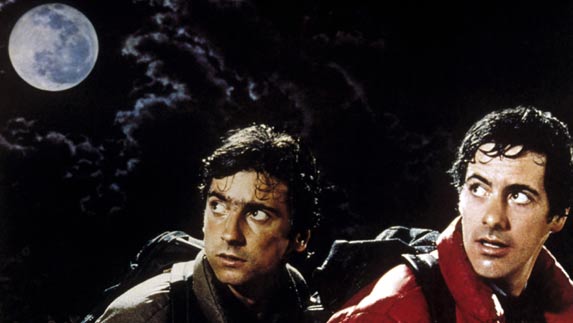
Horrorfest 2010: An American Werewolf in London

AN AMERICAN WEREWOLF IN LONDON is one of those movies any film buff hears about again and again. It's on all kinds of lists. Best horror movies, essential cult films -- even greatest films of all time! I remember in the olden days of the Internet reading about AMERICAN WEREWOLF on film related newsgroups, the same newsgroups that got me to watch the films of Raimi, Romero and Jackson.

But, I've just now gotten around to watching AN AMERICAN WEREWOLF IN LOND and. . . it's great! Turns out everyone knows what they're talking about.

Before WEREWOLF, I'd seen lots of John Landis flicks, the most famous of which is probably ANIMAL HOUSE. So, I was prepared for his slant on college humor. Still, matched up with the horror element here, it becomes pretty irresistable, even if you know what you're in for.

WEREWOLF is the story of two college dudes who are backpacking through Europe. They start out in rainy England, much to their disappointment, dreaming of sunny Italy. This is the equally likable and affable David (David Naughton) and Jack (Griffin Dunne). After stopping in a creepy pub -- the kind where everyone stops what they're doing and stairs at you when you come in -- and ignoring some cryptic warnings about the full moon, David and Jack find themselves attacked by a werewolf in the English countryside. Jack dies; David finds himself in a London hospital, tended to by an alarmingly dismissive doctor (John Woodvine) and a cute nurse (Jenny Agutter) who has her eye on him.

As David convalesces, he suffers strange nightmares in which he stalks the countryside and kills deer with his bare hands (and teeth). Eventually these nightmares give way to day time visitations from the increasingly decayed corpse of his buddy Jack who shows up to let David know that being undead sucks.

Here's an interesting twist on the WEREWOLF mythos: in this flick, anyone killed by a werewolf (an unnatural death) is cursed to walk forever in limbo. That is, until the werewolf bloodline is destroyed. Then, the curse is lifted, and the victims can finally rest in peace. Because the werewolf who killed Jack and injured David was killed in the attack, David is now the last in the werewolf bloodline and Jack pleads with him to kill himself before the real trouble starts when the full moon rises in a few days.

David's understandably worried, but also not entirely convinced. After all, maybe he's just going insane. Or dreaming. Either way, he falls ass backwards into living in the cute nurse's flat and before you know it, the full moon rises.

That's when the kick ass transformation sequence begins. Rick Baker, arguably the greatest makeup artist of the last couple decades, provides the gruesome transformation which, unlike previous werewolf flicks, takes place under bright lights in excruciating detail. There's no cutting away here. Sure, once the werewolf is on the prowl, we get lots of snippets of shots and suggestions of carnage. But as David transforms, we get every painful moment of the process, as his hands and feet contort and twist and a snout protrudes uncomfortably from his face. This is preceded by a funny sequence in which David grows increasingly agitated, pacing the apartment set to the ironically upbeat "Bad Moon Rising" by CCR.

There are a few angles to the humor, here. The first angle is the friendly, joking tone of Jack and David's college age mentality. They're smart enough to crack wise but friendly enough to be gently bemused by everything. It's easy to see why the nurse would be into David -- he has an aloof, amused quality that just seems comfortable. This, contrasted with visits from the the like of the undead and werewolves, creates a consistently funny balance between the mundane and the fantastic.

Secondly, we've got the unflappable, stuffy British natives. With the exception of the denizens of the creepy pub, everyone from police to doctors seem to be fairly unimpressed by the increasingly supernatural events of the plot. The best sequence showcasing this attitude is on David's first night of werewolf attacks in which his victims are so busy being British they almost don't even have time to be proper murder victims. One of them marches to his death with a drink in one hand. Another, alone in a subway tunnel, attempts to speak rationally to David's growls and howls.

The whole thing reaches an exciting and expertly crafted climax in Piccadilly circus, where the crowd's panic causes more carnage than the actual werewolf does. Cars smash into each other, innocent bystanders launch through windows.

As the riot police converged on David and the nurse rushed to his rescue, the climax of the original KING KONG came to mind. Here's why: I cared about David. I didn't want to see him die. It's the way you feel about KONG at the end of the original film -- sure, he's tearing apart the city, but he's ultimately an innocent character who has been pushed into extraordinary circumstances. The thing that makes this movie work is that David is so likable, you really care about his situation. As ludicrous as it is, and as murderous as he becomes, you root for him. Indeed, a strength of the whole movie is that basically every character is totally likable. There's just this feeling of goodwill in the film, despite the gore. That's what's missing in a lot of horror movies today, especially these ones that are obsessed with torture. They forget about humans, they forget about good people. They think because it's a horror film, everyone has to be depraved and nasty. It's simply not true.

I like how David knows enough about classic horror films to compare his situation to the classic WOLF-MAN, even going so far as to describe the plot to his girlfriend in terms of the stars involved. "Bela Lugosi bites Lon Chaney, then Claude Rains kills Lon Chaney," he says.

Later, David has the best line of the movie, as he screams, "Be rational? I'm a fucking werewolf for Chrissakes!"

Like I said, as the climax came down, I didn't want to see David die and I wondered how the movie would possibly come to a satisfying conclusion. Then, it ended abruptly. At first I wondered if I had been cheated. But then, as yet another version of "Blue Moon" blared on the soundtrack and the credits rolled, I realized this was the movie's last laugh and I had to smile.


Monday, October 4, 2010

Horrorfest 2010: Don't Look Now

I get to kill two birds with one stone watching DON'T LOOK NOW -- that's one more film down for horrorfest, and one more I can mark off the list of Ebert's "Great Movies" -- a list I'm working my way through, albeit slowly.

I'd never heard of DON'T LOOK NOW until compiling a list for Horrorfest 2010 -- this 1973 film stars Donald Sutherland and Julie Christie as a couple who has recently lost their daughter in a tragic drowning accident. The sudden death puts some distance between them as they try to recover as Sutherland's character is summoned to Venice to help restore an old cathedral.

Things get weird when two elderly women contact Christie's character after staring at from across an empty restaurant. One of them is blind and reveals herself to be a psychic (Hilary Mason). The other is her caretaker (Clelia Matania). Although they seem to mean well when they tell Christie they've seen an apparition of her dead daughter and that she's "happy," there's something definitely creepy about them.

Sutherland doesn't like it one bit as Christie gets more and more drawn into a relationship with the supposedly psychic sisters. He begins to fear that they're taking advantage of her and also begins to wonder if she might be snapping under the pressure of her loss. The sisters, meanwhile, begin to sense that Sutherland has a "second sight" of his own -- after all, as Christie relates the story of her daughter's death, it's clear that Sutherland attempted to race to her rescue before he could have possibly known that anything was wrong.

Things get even more crazy when Christie is called away to visit her son at a boarding school in England where he's been injured in an accident. In her absence, Sutherland wanders the winding streets of Venice and begins to see ghostly images of his daughter creeping down back alleys. He even sees an image of his wife, who has supposedly left town, in the company of the two mysterious sisters. Add to that the fact that there's apparently a serial killer loose in the streets, and Sutherland decides to take things to the cops.

Anyway, enough plot. Although this is a mystery of sorts with a surprise ending, it's mostly about mood and atmosphere. The other two stars of the film, other than the actors, are the film editors and the city of Venice itself.

From the opening sequence, the film is edited together in a disturbing juxtaposition of unsettling images. The trick is, most of the images on their own might seem mundane enough, but one suddenly butts up against another on odd beats that the audience doesn't expect and the whole thing starts to make you really uneasy as it unfolds. You never know what you're going to see next, or why you're going to see it, and that's basically the opposite of usual film editing, in which one shot seems to predict the next in a seamless flow. There's nothing seamless or flowing here, just a bunch of hard edges.

Similarly, the usually romantically portrayed city of Venice is presented here as a maze of dark alleys, stairways to nowhere and claustrophobic winding streets, most leading to watery dead ends (or graves). Characters are constantly losing locations they've been to before and walking in endless circles, almost as if they're caught in one of those MC Escher optical illusions. People constantly seem to be peering out of windows, and then suddenly shutting the windows as soon as they're seen. On the verge of winter, most of Venice is shutting down and all the tourists have gone home. Even Sutherland's own hotel is eager to get rid of him.

Because of the psychic theme, a lot of the film is put together slightly out of order, so you never know exactly what has already happened or is going to happen. Are these images recalling each other or predicting each other? It's unclear. It all seems to be happening at the same time. There's a love scene early in the film, famous for how graphic it was at the time, that cuts back and forth between the present and the future and plays with time so much it made me wonder if maybe Alan Parker had it in mind when he put together the stream of consciousness PINK FLOYD - THE WALL.

Another spiritual presence in the film, aside from the psychic sisters, is the Bishop overseeing the reconstruction of the cathedral Sutherland's character is working on. As played by Massimo Serato, the Bishop is worried for the well being of Sutherland but seems somewhat detached from the more immediately emotional spiritual world by the trappings of dogma and tradition.

"I wish I didn't have to believe in prophecy," he tells Sutherland. "I do, but I wish I didn't have to."

By the end of the movie, as Sutherland feverishly attempts to make logical sense out of a story that can't be rationalized, I think he thinks the opposite. He wishes he did believe in prophecy. He doesn't, but he wishes he did.


Sunday, October 3, 2010

Horrorfest 2010: The Horror of Dracula

I've been looking forward to seeing THE HORROR OF DRACULA for a long time. I don't know why I never watched it earlier. Growing up, I was obsessed with the classic era of Universal monster movies (DRACULA, FRANKENSTEIN, all those guys) and would read any book I could find on the subject. The books always mentioned the second wave of horror films in the late 50s and 60s from Hammer Studios in England. Everything in print made those Hammer films seem way more scary and adult than the Bela Lugosi and Boris Karloff monsters I was used to -- the publicity stills almost always had bright red blood splattered everywhere and even the name of the studio itself -- HAMMER -- seemed so harsh and unrelenting. And, at the time, the films all seemed so modern -- turns out, they're just relatively modern compared to the films of the early 30s, but looking back from 2010 they're still pretty old fashioned.

Anyway, HORROR OF DRACULA was the first of these. It's basically a remake of the usual DRACULA story, but there's a lot of twists that deviate from the source material and films that came before it. Some of them are welcome surprises while others are just weird.

Just looking at the cast list is exciting. It has been plundered over the years by the last few decades' best and most popular filmmakers -- Christopher Lee stars as Dracula and later appeared in Peter Jackson's LORD OF THE RINGS movies. Peter Cushing is Dr. Van Helsing the vampire hunter, and he was Darth Vader's boss in STAR WARS. Michael Gough is Arthur Holmwood, and he spent about a decade playing BATMAN's butler for Tim Burton.

The film opens like most DRACULA stories do, with Jonathan Harker (John Van Eyssen) coming to visit Count Dracula (Christopher Lee) in his castle. But, it isn't long before Harker reveals as he writes in his diary that he actually knows all about Dracula's vampire status an, unlike his literary counterpart, this Harker has arrived specifically to kill Dracula. Unfortunately, he's no match, and before you know it, Dracula's on his way to terrorize Harker's fiance, Lucy (Carol Marsh).

Here's where I start to wonder if I remember the book correctly. Harker marrying Lucy? I thought he was marrying Mina? But, when they cut to Lucy's home, she's living with her brother, Arthur (Michael Gough) and his wife Mina (Melissa Stribling). But in the book, wasn't Lucy engaged to marry Arthur? Now I'm all confused.

Oh well. That's beside the point. The point is, Dr. Van Helsing (Peter Cushing) follows Harker to Dracula's castle, figures out what's going on, and returns to rescue Lucy with his vampire hunting expertise.

Here's the thing: Cushing and Lee are both badasses in this movie. But, they're both under stated and fairly tame. The whole movie reeks of decadence and operatic over dramatization, but Cushing and Lee resist chewing the scenery, most of the time. And, the screenplay doesn't really give them any super powers to work with, either. Lee's Dracula is probably one of the most human Draculas I've seen on screen -- he doesn't transform into animals, for instance, and although he appears to be a fairly refined gentleman, he doesn't waste too much time with the sweet talk and is far from poetic. He's mostly just a pissed off, dry, humorless creep you don't want to mess with who happens to look really good standing at the top of a big ass stair case wrapped in a cape. Which is kind of Cushing plays Van Helsing, too -- he's not the kind of guy who will start shit with you, but a glare from him will start you walking on egg shells.

The film is in beautiful color that really shows off the red blood, and Terence Fisher's direction is a model of efficiency. The movie clips along at a great pace, and there isn't a shot that doesn't need to be there.

Of course, Lugosi will probably always be the greatest Dracula there ever was, but Lee makes the part his own, which is a big part of what makes this movie so great.


Saturday, October 2, 2010

Horrorfest 2010: A Nightmare on Elm Street

A NIGHTMARE ON ELM STREET is one of those movies I feel like I've seen even though I don't think I ever really sat through the whole thing until earlier tonight. Then again, now that I've sat through it, I'm starting to think maybe I have seen it after all. Oh well, whatever.

Continuing with the dream theme from VAMPYR, NIGHTMARE is the by-now famous story of the kids on Elm Street who are haunted by the ghost (I guess?) of child murderer Freddy Krueger (Robert Englund) in their dreams. He can kill them in their dreams. He can follow them out of their dreams and kill them in the real world. Like a dream, he can manifest himself in a bunch of different shapes and sizes and defy the laws of physics.

I imagine if I'd seen this movie as a kid it'd probably be a lot more effective now. These days, it's not really that scary, and although the film isn't intended to be taken totally seriously, there are still a few unintentional laughs to be had. For instance, I know the whole "running but not getting anywhere" thing is a common component of many nightmares, but when you literally see it played out by an actress on screen, it looks kinda silly.

That said, the death scenes are incredibly creative and, unlike most slasher movies, because of the blatantly supernatural element of the film, they're allowed to be as off the wall and over the top as possible. NIGHTMARE succeeds where FRIDAY THE 13th, for one example, fails, because it makes sense that Freddy is basically invincible, whereas you're never quite sure what the deal is with Jason. Also, the imaginative ways Freddy manifests himself and dispatches his victims are a little less morbid than your average slasher film because it's all about nightmare imagery and not so much about thinking of demented ways to literally kill people.

I also like how the kids being haunted by Freddy are the unwitting objects of revenge that should be visited upon their parents -- only, their parents never told them their gruesome secret, so the kids are totally in the dark.

Also, the structure of the first half of the film is pretty cool, pulling a little bit of a narrative twist Hitchcock would have been proud of involving the film's heroine.

Oh yeah, and the film features Johnny Depp's film debut. So there's that.

Friday, October 1, 2010

Horrorfest 2010: Vampyr

I had so much fun watching and writing about 31 horror movies in 31 days last October that I've decided to do it again. Last time I originally planned to just watch my favorites that I happened to have on hand, but that evolved into me watching a bunch of movies I had never seen before. There wasn't much rhyme or reason to it, though -- I mostly watched whatever happened to be available on Netflix via the watch instantly option, or whatever happened to be playing in town.

Anyway, this time I decided to look up a "100 best" list to work off of. I'd seen about half the movies on the list I settled on, so I'll be watching 31 of the other half of the list in no particular order. First up:

VAMPYR

I've heard of this flick before but never watched it until now. It's an old German/French co-production from 1932, directed by Carl Theodor Dreyer. I've seen at least one of his films before, THE PASSION OF JOAN OF ARC, which was kind of a horror story in and of itself, depicting the trial, torture and execution of Joan of Arc.

Going into the movie I assumed it was a silent film, but it turns out it's actually a very early sound film. So, it still relies heavily on a lot of silent techniques, like extensive use of title cards. But, atmospheric plays throughout and there is some sparse dialogue and a few sound effects here and there.

The movie is light on plot and heavy on atmosphere -- almost more of a stream of consciousness nightmare than an actual story with a beginning, middle and end. At the beginning we're told through narration that the main character, Allan Gray (Julian West), is a student of the occult and has been so entrenched learning about witch craft and devil worshippers that he sometimes can't even trust his own eyes anymore and can't always tell the difference between dream and reality. So, appropriately, much of the movie walks that fine line, too.

Gray is wandering through Europe, stops at a weird creepy inn, and becomes involved in a mystery that slowly unravels to reveal a local Vampyr sucking the blood of some locals while using other locals as slaves to help her in her crimes. The first half of the film is a lot of Gray wandering around abandoned buildings, witnessing strange sights -- a guy who appears to be a grim reaper taking a ferry across the river, shadows that seem to have minds of their own, bustling about. That kind of stuff. The second half deals more with the reality of the situation as Gray realizes he's dealing with a Vampyr and sets a plan in motion to destroy the monster and her accomplices.

The dream like, or, I guess, nightmarish quality of the film is actually heightened by the antiquated techniques the movie uses. For instance, the primitive sound recording techniques results in sparse sounds that seem kind of half heard -- characters speaking right in front of you seem to have voices that are coming from other rooms. Sound effects that are supposed to be coming from actions right in front of the viewer seem to echo from some other dimension. Old films like this often feel alien enough because times and technology have changed so much, but this one is even more alien than usual.

That said, VAMPYR also seemed startlingly modern in places. All you have to do is compare it to the much more famous Todd Browning verion of DRACULA starring Bela Lugosi to see what I mean. DRACULA is from 1931, VAMPYR was shot around the same time and released in 1932. Even though they're so close in age, there's a huge difference in style. Despite its classic status, DRACULA is somewhat infamous for being overly talky, lacking in atmosphere after the first few minutes, and unimaginatively shot in boring drawing rooms. VAMPYR, on the other hand, is full of energetic tracking shots that follow characters down hallways, into doorways, and around corners. VAMPYR also uses a lot of crazy angles and juxtaposes strange unexplained images in ways that would make Salvador Dali proud. There's even a coffin-eye-view shot of a funeral procession. VAMPYR is as much of an experimental art film as it is a horror one.

You always have to take movies as old as this one with a grain of salt. There's a disconnect between the film and a modern viewer that you're just going to have to accept and get over if you're going to give it a chance. It's only a little over an hour long, but that's a long drawn out hour and I'd be lying if I didn't admit I checked the clock more than once. Still, the movie is definitely creepy and definitely unique, and probably one of the best representations of a dream like state that I can remember seeing on screen.