Monday, February 27, 2017

Romancefest 2017: Indecent Proposal

Yet another in a long line of movies I was aware of but never saw, this fourth film from Adrian Lyne for Romancefest proves to be a little bit of a backslide for him: INDECENT PROPOSAL drops back from the crowd pleasing, Oscar-worthy FATAL ATTRACTION and lands firmly in FLASHDANCE territory.

This is the movie where Robert Redford offers Woody Harrelson and Demi Moore a million bucks for a chance to sleep with Moore. Harrelson and Moore have just lost their life savings in a last ditch effort to win enough money gambling in Vegas to pay for their dreamhouse.

They accept, the whole thing eats away at them, their relationship falls apart, Moore ends up with Redford, but then Harrelson and Moore are drawn back together.

It's strange – the movie focuses mostly on the aftermath of this arrangement. While it's easy for me to believe that this kind of thing would have a big and far-reaching fallout within a married couple, it's less interesting to see how Redford, as a billionaire, continues to court Moore and how Moore goes along with it.

A more interesting film would zero in on the night in question, I think. Maybe even in an isolated environment. For some reason I got the idea in my head a long time ago that this movie took place on a cruise ship, so all 3 of our principals are stuck together, Redford makes his offer, gets a night with Moore, and meanwhile Harrelson is stuck there like a dummy on the same ship, unable to escape. Of course, that's not what happens at all, but I kind of wish it did.

Also, Redford basically turns out to be an okay person, I guess, as far as these things go, and it might have been more interesting to have him turn out to be a total creep. Or have Harrelson turn out to be a total creep. Or Moore. Instead, none of them are. It's hard to find drama among 3 pretty easy-going people.

We kind of have the same problem here as we had with NINE ½ WEEKS – we've got kind of a depraved, kinky, thrilling story but it's told with an attempt to appeal to the middle of the road as much as possible. NINE ½ WEEKS takes a few more risks, in this respect, but they're both afraid to go all out when it comes to following their own premises.

Anyway, it's kind of a bummer way to end ROMANCEFEST 2017, but there you have it.

Romancefest 2017: The Age of Innocence

I saw THE AGE OF INNOCENCE years ago, before I was really in my film buff phase and before I really knew who Martin Scorsese was. So, it was high time I gave it another watch, and what better chance to do so than Romancefest, since it's super romantic.

Based on the novel by Edith Wharton, THE AGE OF INNOCENCE takes place in 19thcentury New York among high society and stars Daniel Day Lewis as a man torn between his fiancé (Winona Ryder) her cousin (Michelle Pfeiffer) who has just returned from Europe to New York to divorce the Count who has taken her money.

Most of Roger Ebert's writing on THE AGE OF INNOCENCE centers on the fact that it's about a society where no one can say what they're really thinking or feeling out loud even though they all project what they're really thinking and feeling through body language or looks. So everyone knows everyone's business but pretends not to, and you kind of enter into society agreeing to play along with those rules. Narration by Joanne Woodward guides the audience through some of this stuff, otherwise we might miss it, since this world is alien to us.

This basically ruins Lewis' life – he makes the wrong decisions at the wrong times and never gets to be with the woman he really wants because he's playing society's games and so is everyone else. The only one who doesn't seem to care is Pfeiffer, but which is what makes her so attractive to Lewis, but she's happy to let Lewis dig his own grave, if he won't grow a backbone and stand up for himself.

Scorsese said this flick was his most violent, which is funny, since there's no on-screen gore. I guess what he meant was it's the most brutal, emotionally speaking, and I think he might be right. At least the characters in his other films, however repressed they might be, get to flip out at some point. Not so in THE AGE OF INNOCENCE – here they're trapped.

Romancefest 2017: Jungle Fever

Did you know JUNGLE FEVER is a pretty tragic drama and not really a comedy? I didn't! Until now. I don't know if it was the marketing or the kickass Stevie Wonder song or what, but I was surprised when I sat down to watch JUNGLE FEVER just how sad it was.

Here we have two movies about affairs back to back – this time around it's Spike Lee directing (and co-starring) with Wesley Snipes, who is  a happy family man until he meets an Italian-American woman at work (Annabella Sciorra) and ends up sleeping with her. The rest of the film details their trials and tribulations when Snipes loses his family, moves in with Sciorra, and both deal with racism re: mixed couples.

Being a Spike Lee flick from the 90s this is not just about white people rejecting a mixed couple. It's also about discrimination between lighter skinned and darker skinned blacks people, black women disapproving of black men dating white women, Sciorra's Italian-American family treating her like a slave, ridiculing her "weak" pre-Snipes boyfriend (John Turturro) and, of course, being racist.

There's also a subplot with Samuel L. Jackson as Snipes' crack-addicted brother and how his addiction leads him to disappoint and take advantage of his otherwise peaceful parents (Ossie Davis and Ruby Dee).

As usual, whether dealing with comedy or drama or both at the same time, Lee takes things to operatic heights, with the help of an overactive Terence Blanchard score. As usual, I admired this – the most recent Lee flick I saw was CHI-RAQ, and that was similarly over the top, divisive among viewers because of it, but that was exactly what I loved about it. If you're gonna go, go for broke.


Romancefest 2017: Fatal Attraction

The third time's the charm for Adrian Lyne this Romancefest with FATAL ATTRACTION, by far the best of his 3 films I viewed this month. I guess it just had the strongest story and that was all that was really missing from Lyne's other efforts. Who knew.

Michael Douglas stars as a legal dude at a big publisher who is happily married and has a kid. He meets one of the editors (Glenn Close) at the publishing company at a company party, his wife (Anne Archer) leaves for the weekend, one thing leads to another and Douglas and Close are knockin' boots.

After their one night stand, Douglas foolishly thinks he can move on with his life but Close has other things in mind. Douglas also foolishly gives in and spends the weekend with her, and THEN thinks he can move on with his life, but Close STILL has other things in mind (attempted suicide).

So, now: Douglas is trapped between wanting to hide the affair from his life in an effort to keep his family together, and having to appease Close, who begins to act increasingly erratic and threatens to expose him if he doesn't do what she wants. He tries everything, including moving to the country, but no dice. Close will not give up and things escalate to animal abuse and kidnapping.

This movie was obviously a big hit but did you know it was nominated for best picture? Well, it was. I liked it, too. Like a good Hitchcock movie, the story deals with something anyone can identify with – a guilty conscience. Like, I'm not saying everyone's an adulterer, I'm just saying everyone's done something once or twice they were afraid might come back and bite them in the ass at some point.

Sunday, February 26, 2017

Romancefest 2017: Broadcast News

I started to watch James L. Brooks' film BROADCAST NEWS for a previous Romancefest before deciding to take that year's list in another direction and starting over again. But now I'm back! And it's a good movie.

After a fun opening in which we meet each of the movie's characters as little kids, BROADCAST NEWS settles into a love triangle following an ambitious TV news producer (Holly Hunter) and two reporters: idealistic, intellectual but unpolished Albert Brooks, and well-spoken and handsome but not-so-bright William Hurt. Actually, Hurt IS bright but he just doesn't write his own stories and doesn't know much about current events. And Brooks isn't exactly a schlub, but he is when put up against Hurt.

Aside from dealing with the love triangle, the movie also explores the changing nature of the news media at the time (1987) and the morals and ethics of journalism in general. It's actually a little sad to look back on what this movie considers scandalous, since things have just gotten so much worse. For instance, the idea of a pretty face reading the news, but not writing it or understanding it, is approached as completely foreign to these characters. Meanwhile that's par for the course, now. Also, a crucial plot point hinges on Hurt editing an interview to exploit and somewhat misrepresent the emotions involved in it, and this is a breaking point for Hunter when it would be a normal day at the office for most producers today, I'd imagine.

So, the movie is both ahead of its time and behind the times, as it was smart enough to question all this bullshit but idealistic enough not to realize things were about to become ten billion times worse.

The movie has both a smart and funny script as well as three incredible leads. Hunter is perfect at playing both tough and vulnerable, Brooks, as always, effortlessly does smart and sarcastic, and Hurt has possibly the hardest part of all, as he plays the pretty boy who should be easy to hate, but does it with enough humility and sincerity that you kind of root for him, some times. That's what makes a good triangle: if you pretty much like everyone involved. Even the supporting cast is good with Jack Nicholson as a slimy anchor and Joan Cusack as a devoted assistant.

There's a famous sequence in this film in which Hunter is feeding Hurt lines through an earpiece and the two click on an intimate level as they're able to cobble together a story in real time, live on television. It's a pseudo-sex scene in which the editing, acting and sound design all comes together to put together a symphony of feelings. This is the essence of cinema -- purely visual storytelling, from all departments coming together in collaboration.

Romancefest 2017: Sid and Nancy

It's about time I got around to watching SID AND NANCY. I only walked by the poster in the Hollywood Theatre's bathroom about a thousand times before they took it down.

This is the energetically told, but tragic, tale of real life lovers, Sid Vicious (Gary Oldman) and Nancy Spungen (Chloe Webb), as directed by Alex Cox. As you may know, this is Sid Vicious of The Sex Pistols, the band famous for ushering in an era of punk rock while barely knowing how to play their instruments (even though I think they're full of shit and probably knew how, so there). The Sex Pistols also include Johnny Rotten (Andrew Schofield) who grew up to do a morning radio segment that used to piss me off when I was 12, before showing up on  JUDGE JUDY, perhaps the most punk rock show ever aired in the history of syndication.

Anyway, if you ever feel like not doing heroin, watch this movie. Because it's about how bad heroin sucks. Sid Vicious goes from rock star on top of the world to dead within the span of what seems like not very much time at all. Here's the thing: when the other Sex Pistols are annoyed that you party too much and want to kick you out of the band, you have a problem.

This is a pretty insightful movie about the dangers of a co-dependent relationship, as Sid first becomes attracted to Nancy after feeling sorry for her being shunned by his peers. She's a drugged out groupie when he meets her, and eventually introduces him to heroin and leads him along his path to addiction. But even without the drug, you get the impression the two would be a volatile combination, as they spend their days and nights fighting, arguing, making up, etc. Even if you haven't ever been in the situation where you're sitting up all night waiting for your next fix, you might be able to identify with two lost souls who only have each other to love and berate as they both decline into the hell that is being trapped alone in a room together.

Or, maybe you won't. Maybe it's just me!

The movie begins with Nancy's death, apparently at the hands of Sid, and flashes back to the beginnings of their relationship, and then catches back up with the beginning at the end, so we know going in that this is going to be a tragedy, even if we don't know anything about the Sex Pistols. Again, even if you've never been an addict or a rock star, you might think, there but for the grace of God go I.

Probably the most interesting thing about the film in retrospect is Oldman's performance. If you're used to him as a respected and established actor, it's fun to go back to this early performance and see him as a young force of nature. If this was a nobody you'd assume this was just how the actor is and the director captured it. But we know this guy grew up to be Gary Oldman, so it's clear this is just an insanely good performance. Speaking of good, the direction is great, and it's a wonder Alex Cox didn't go on to bigger things.

Incidentally, I was surprised to notice that it turns out Courtney Love has based her entire life on this film and has been pretending to be Nancy all this time. Go figure.


Romancefest 2017: Nine 1/2 Weeks

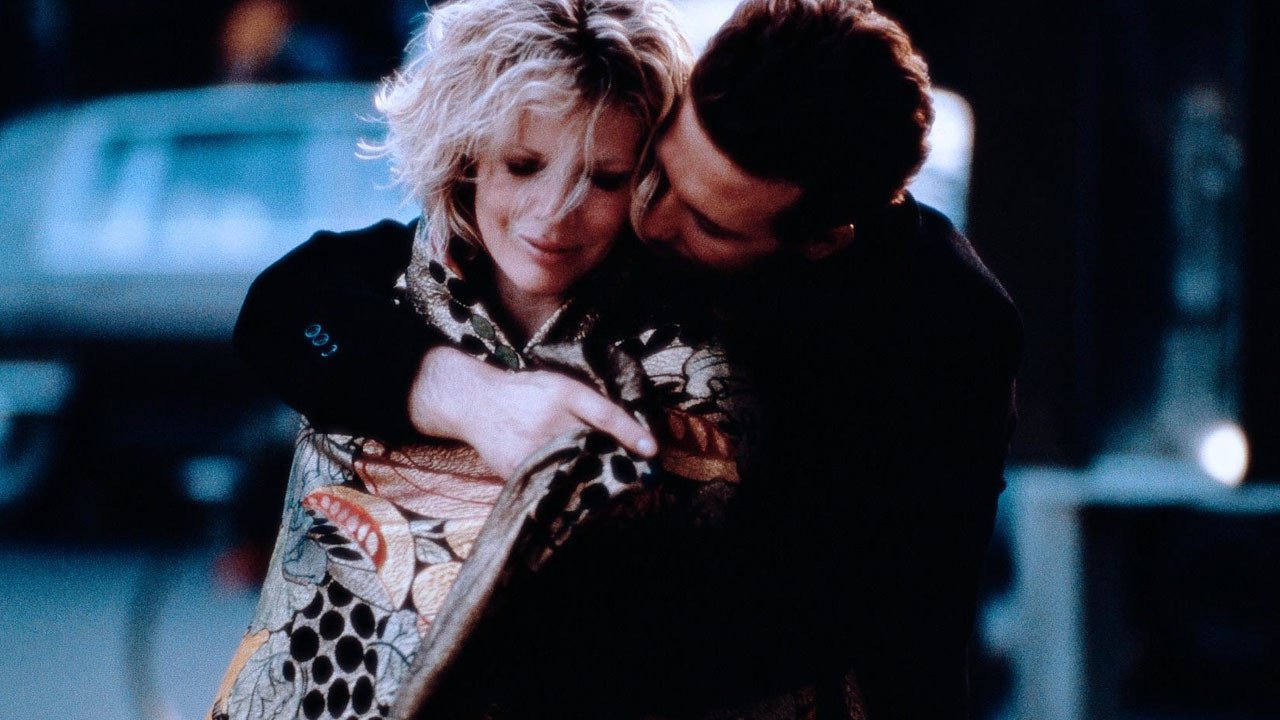
Here comes the 2nd Adrian Lyne film of Romancefest, NINE 1/2 WEEKS. Does it make more sense than FLASHDANCE? Sorta. Does it have lots of montages? Yes!

Known for being sexually explicit and for having a lengthy sex-with-food sequence (lampooned in the arguably better film HOT SHOTS!), NINE 1/2 WEEKS stars Kim Basinger as a New York City art dealer who falls in love with a Wall Street guy (Mickey Rourke). Rourke plays mind (and sex) games with Basinger to the point that she starts to lose parts of herself and transform into what basically amounts to a sex slave, coerced into doing things that alternatively humiliate and empower her by Rourke's emotionally manipulative mood swings between intense intimacy and detached coldness.

Sound familiar? Methinks E.L. James of FIFTY SHADES OF GREY fame might have seen this flick.

So, since Lyne directed both FLASHDANCE and this flick, let's use FLASHDANCE as an example to measure this film against. I feel like this movie and FLASHDANCE are kind of opposites. For example, where technicaly wizardry is the strength of FLASHDANCE, it's the weakness here. This movie, perhaps in spite of itself, actually does have characters and story going for it. I'm not sure how much of this is actually from the screenplay and how much of it is from Basinger and Rourke turning in three dimensional performances. Maybe it's both.

In any case, I feel like the real stuff is undercut by the slick Hollywood style of the flick. For instance, there's a sequence in which Basinger and Rourke go for a night on the town with Basinger dressed as a dude. That's fine, whatever. But! They run afoul of some people on the street who take exception to their apparently homosexual tryst, end up on the run, and find themselves in a dark alley with homeless people (or something) and in the middle of a knife fight. After all that, they make mad passionate love in the rain, in the alley, etc. The problem is, it looks like it's shot on a set with perfect lighting. It doesn't look like two people banging in a dirty alley. So it's like, who cares if they get turned on by a knife fight and bang in an alley if the alley looks like the cover of a romance novel. Where's the danger? What's the point?

So, the best stuff in the movie is not visual, it's in the emotions and the minds of the characters. And for the most part, this is fine. Basinger has her shit together enough to tell Rourke to fuck off every now and then, so at least it's not a totally unbelievable relationship. And Rourke hints both that he likes Basinger more than he lets on and that he has some emotional trauma he's dealing with, so he's not just a robot monster.

Still, the way the story's told you have to wonder about a couple sequences. For instance, early on when Basinger and Rourke hardly know each other he takes her to an amusement park and then pays a carny to let Basinger ride the ferris wheel alone and then strand her at the top of the ferris wheel. After that, both the carny and Rourke walk away, leaving Basinger screaming for help and obviously unhappy with the situation. I realize in the context of the movie this is one of Rourke's mind games. But, it's so extreme and so out of nowhere and so early on and Basinger freaks out so much you have to wonder why the relationship even progresses after that. Like, at that point, Rourke's just being a dick. He's not being all charming and mysterious. He's just being a dick.

Still, once you get by that weird scene and roll your eyes at the various montages, there is some interesting stuff going on with the push and pull between Rourke trying to control Basinger and Basinger sometimes giving in and sometimes not. It would have been even more interesting if the movie would have been willing to follow the characters down darker and grittier paths, but it didn't. So instead it's just weird.