Let's go back to Germany for GOOD BYE LENIN, the 2003 flick from director Wolfgang Becker about an East German kid (Daniel Bruhl) who goes to great lengths to keep up the illusion of communism after the wall has come down.
Early on, we see flashbacks showing our hero as a little boy (Nico Ledermuller), illustrating how devoted to the Communist Party his mother (Katrin Saβ) is. She's recently broken-hearted, after her husband has fled to the west, and, after a brief catatonic state, becomes determined to raise her children in the best East Germany that she can.
On the eve of the Berlin Wall being torn down, Bruhl's mother collapses when she sees him being arrested as a protestor. She goes into a coma and does not wake up from it until after the wall is gone and freedom is on the march. The doctor tells Bruhl any minor shock could cause his mother to relapse and possibly die. Knowing the Brave New World will likely frighten his mother to death, Bruhl conspires with his sister (Maria Simon) and neighbors to make it look like East Germany and communism are still intact, as long as he can.
It's a funny and intriguing premise, and fairly well executed, but you're probably wondering where the romance is. Well, Bruhl does fall for his mother's beautiful but no-nonsense nurse (Chulpan Khamatova) and a romance does blossom, but I have to admit I was kind of wondering why this showed up on a romance list.
The greatest love story here is between mother and son, and it's actually portrayed nicely, though not normally what you'd think of when it comes to romance.
Perhaps the greatest weaknesses of the film lie in director Becker's stylistic flourishes, all obvious references to other (greater) filmmakers like Stanley Kubrick and Danny Boyle. He's clearly a student of cinema history, and clearly an enthusiastic director, but maybe a little too obvious. The movie's fun and inviting but if Becker's trying to score movie nerd points, he's trying a little too hard.
Thursday, February 26, 2015
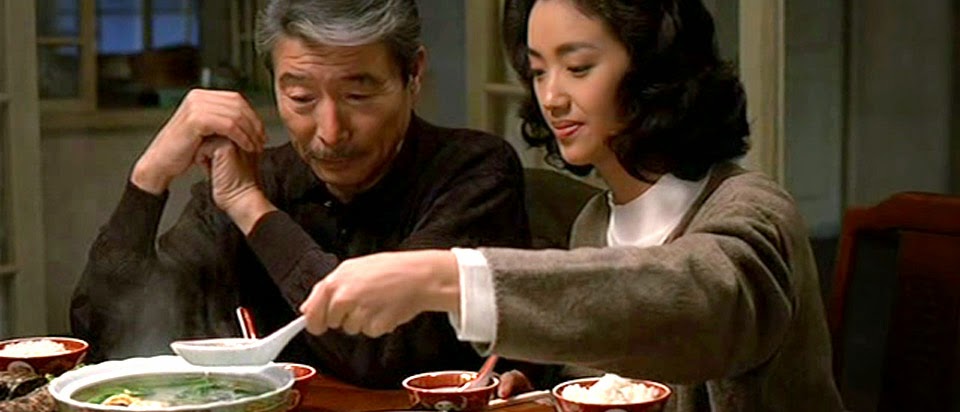
Romancefest 2015: Eat Drink Man Woman
What a
beautiful movie! Ang Lee's Taiwanese flick from 1994, EAT DRINK MAN WOMAN, is
beautiful not only to look at but also in spirit. This is really a "warm
fuzzy" movie, as they used to say in pre-school.
Sihung
Lung stars as a widowed father of three daughters, all of whom still live at
home. They're all pursuing their individual lives and are getting ever closer
to leaving the nest, and the only time they spend together is an elaborate
weekly dinner Lung prepares for them.
Much of
the movie's magic comes from the close attention paid to the rituals of cooking
and eating. Lee's camera lovingly studies every ingredient, every method, every
detail of Lung's (and others') complex, beautiful, fragrant, delicious dinners.
Lee even captures the beauty and chaos behind the scenes of a giant restaurant
kitchen, his camera floating freely amid the confusion.
The
oldest daughter (Kuei-Mei Yang) has been single ever since her heart was
broken, recently converted to Christianity, and teaches at a school where
mysterious love notes have started showing up for her.
The
middle daughter (Chien-lien Wu) is a successful executive at an airline who has
recently purchased her own apartment and scored a promotion. She's also the
only daughter to follow in her father's culinary footsteps, lamenting she was
never allowed to cook since her father was always in charge, but that she loved
playing in the kitchen when she was a child, and can now whip up a feast
rivaling those of her father's when she visits her boyfriend.
The
youngest daughter (Yu-Wen Wang) is a college student who works at a Wendy's and
strikes up a relationship with her co-workers on-again/off-again boyfriend.
The
passage of time is measured in who shows up to dinner, how many, who doesn't.
All major family moments happen at the weekly feasts, usually in the form of
announcements from the daughters. Dad's not always the most open, but he
eventually does open up after a little booze in an amusing scene near the end
of the flick.
There
are a lot of little things to love about this movie, including a subplot in
which Lung goes out of his way to start cooking a multi-course lunch for his
elementary-age niece.
EAT
DRINK MAN WOMAN does one of my favorite things that great movies do: it pays
great attention to detail. This is not a story about the comings and goings in
a general family. This is a very specific family, in a very specific place. The
setting is vividly drawn through the use of the food, and that alone makes the
movie unforgettable.
Romancefest 2015: Aimee and Jaguar
Now we
travel to WW2 Germany for 1999's AIMEE AND JAGUAR, starring Maria Schrader as a
young Jewish woman who has obtained a fake identity and works a job at a Nazi
propaganda newspaper, putting her in a front row seat to see the last days of
Berlin.
She's
also a lesbian, engaged in a sometimes platonic, sometimes romantic
relationship with a maid (Johanna Wokalek) to an Aryan housewife (Juliane
Kohler) who is married to a Nazi (Detley Buck). It isn't long before Schrader's
gaze meets Kohler's and she sets sights on conquering the seemingly
unconquerable – can she seduce an anti-Semite who is married to a Nazi?
What
begins as a dangerous game blurs into the realm of real romance, and serves as
just another example of Schrader's flirtations with danger in a dangerous
world. Just living is dangerous for her – a Jew in the heart of Berlin,
hobnobbing with the elite, can't help but live with danger. This relationship
starts out as just another risk but develops into something more as Kohler's
unexpectedly returned and intense affection changes Schrader.
The
script delves surprisingly deep into relationship issues, not content to just
rest on the fact that it's a Jew/Nazi lesbian love story. Rather than allowing
the characters be the one dimensional reflections of their titles, it allows
them to be real three dimensional people who have thoughts, feelings and
opinions. In one particularly powerful scene, Kohler takes Schrader to task for
treating her no better than her husband or other suitors have – as someone who
can just be left alone and abandoned when it's convenient.
Romancefest 2015: Water
This
might be the most tragic movie of Romancefest 2015. The ending snuck up on me,
and although I enjoyed most of the movie, if you had asked me halfway through
if I thought it was going to make me cry, I would have said no. And then I
would have been wrong!
Another
female director, Deepa Mehta, takes on the story of widows in India circa 1938.
Hindu widows had three options at the time: die with their husbands, go into
exile and poverty or, if the families agree, marry their dead husbands' younger
brother.
Unfortunately,
these rules coexist with the practice of marrying people as children, so as the
movie opens we learn that a 7-year-old girl (Sara Kariyawasam) has suddenly
found herself widowed and now faces the prospect of living the rest of her life
in a crumbling home where other (much older) widows live out their lives,
alone.
Among
the widows we have the bloated tyrant (Manorama) who pimps out the most
beautiful widow (Lisa Ray) on the side. On the other end of the spectrum, there
is the wisest and kindest of the widows (Seema Biswas) who becomes a mother
figure to our 7 year old protagonist.
The
romance comes in as a young, open-minded follower of Gandhi (John Abraham)
falls in love with Ray and pursues a relationship with her even though it is
unheard of for a widow to re-marry.
Discussing
the ending and why it is so tragic and tear jerking would get into spoiler
territory, so I don't want to do that. Instead I'll say the movie's beautiful
to look at and recommend you check it out yourself. The powerful ending makes
it worth it.
Romancefest 2015: Still Life
China's
STILL LIFE, a 2006 flick directed by Jia Zhangke, is unlike any movie I've ever
seen. It is not a traditional romance, at all, but it is about two characters'
searches for their husband or wife, respectively, set against an almost
apocalyptic backdrop of a changing society.
STILL
LIFE brings a coal miner (Han Sanming) and a nurse (Zhao Tao) from their
province of Shanxi to Fengjie in search of their loved ones. Fengjie is
crumbling as the community gets ready for the completion of a monstrous dam
that will raise water levels so high that most of the city will be drowned in
the process. It seems the biggest part of the economy, at the moment, is
demolition – the characters wander through and live among demolished buildings,
surrounded by rubble.
That
might sound ugly, but the greatest strength of the movie is its beauty. Even
though it is set among the urban ruins of a city straddling a polluted river
under a smoggy sky, shot after shot features breathtaking scenery and memorable
images.
Our two
little lonely characters make their way through these huge landscapes, dwarfed
by the world around them, in two separate but parallel stories of survival.
Han
Sanming is particularly endearing as the coal miner who ends up working with a
demolition crew and forming a bond with his co-workers as he searches for his
wife. He's not to be messed with (he calmly pulls a switch blade on a con-man
in the opening scene) but he's also not dangerous or unpleasant – just a quiet
man who is on a mission and willing to do what he has to do.
Romancefest 2015: The Piano
That's
right, it's THE PIANO, another movie I kinda/sorta saw when I was 13 but now
I'm watching again as if it was the first time! Another female-directed entry
into Romancefest, this one comes to us by way of Jane Campion and New Zealand.
Holly
Hunter stars as a mute widow who travels to the wilds of New Zealand with her
young daughter (Anna Paquin) when she's married off to a cold and distant
frontiersman (Sam Neill). The only thing Hunter loves that brings her comfort
is her piano, which makes the journey but is abandoned on the beach rather than
lugged through the jungle to Neill's small cabin.
Neill's
friend and local rugged individualist (Harvey Keitel) hatches a plan to trade
land for the piano when he realizes how much it means to Hunter – once he
possesses the piano, he might possess her, as well. And so he does, as he
trades her time at the piano for a chance to watch her, touch her, and
eventually, sleep with her.
Of
course, this tenuous arrangement has its problem. For one thing, Keitel and
Hunter start to fall in love with each other. For another, Paquin starts to get
restless during the piano sessions. And finally, Neill starts smelling a rat.
This is
an intriguing premise and not the kind of thing you see a lot in mainstream
movies – the somewhat sordid relationship between Keitel and Hunter evolves
from somewhat abusive (if mutually beneficial) to eventually become something
both parties want, and the closer the two characters get, the more Neill loses
his grip.
Neill
has probably the most thankless part here as the stuffy, unsatisfying (and
unsatisfied) husband. He tries to be a nice guy, but he's simply not cut out to
deal with a strong woman like Hunter. Still, he acts his ass off. Most probably
remember the movie for Hunter and Paquin's performances, and rightfully so, but
Neill's an unsung hero, here.
A
little less effective is Keitel – he gives the role his all, but he may have
been miscast. Well, it's not his fault. I still love him.
Monday, February 23, 2015
Romancefest 2015: Bad Education
Goddamn
Pedro Almodovar is awesome. I've been slowly but surely making my way through
the Spanish master's filmography over the years and film after film is
colorful, fun, tragic, emotional, original and fantastic. 2004's BAD EDUCATION
is no exception. Go read Ebert's review: it's better than this one.
Gael
Garcia Bernal pulls double or triple duty in this film within a film within a
memory within a short story within, within. Let me see if I can unpack it real
quick: Bernal approaches a filmmaker (Fele Martinez) with a movie idea he
claims is based on their childhood together as friends/lovers at the Catholic
school they attended as children. The filmmaker doesn't immediately recognize
his supposed long lost friend, but gives the screenplay a read anyway. It's
both a re-telling of their time together as children as well as a fantasy about
what meeting again later in life might be like.
As the
filmmaker reads, the film plays out, and Bernal now stars as the character he
wants to play in the movie, himself – imagined as a drag queen named Zahara who
goes on a revenge quest to destroy the evil priest who molested him (or her)
(Daniel Gimenez Cacho).
Without
giving too much away, as the two conspire to make this film happen, reality
blurs with fantasy, not all is as it seems, and more of the real story comes
out, including a visit from the real evil priest (this time Lluis Homar). The
movie jumps from the past to the present, with Nacho Perez and Raul Garcia as
the younger versions of our two main characters, two boys who fall in love with
each other at the movies. Almost every character in this movie is played by a
different person at one time or another, seen through a different point of view
or from a new angle.
If
you're into Almodovar, just rest assured this has everything you love about
him. If this is your first Almodovar flick, it's as good a place to start as
any, and you're in for a treat. The opening credits bring to mind many
Hitchcock movies, and the subject of the flick is reminiscent of VERTIGO. It's
not a stretch to put Almodovar up there with a great like Hitch.
Subscribe to:
Posts (Atom)